Corn Services

Warm Germination
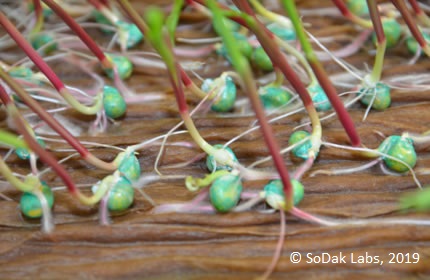
Each germination test consists of 400 randomly selected pure seeds. When testing Refuge-in-a-Bag (RIB) blends, 400 seeds of the major component and 200 seeds of the minor component, or refuge, are tested. This test utilizes Top of Crepe Cellulose Paper (TC) as the media.* Percentage of normal seedlings is reported. Additional information regarding percent of abnormal and dead seedlings, growth characteristics, and a rating of sugar leakage, fungal and bacteria species present are available under Raw Data on the report. This test is required by the Federal Seed Act (FSA) for labeling and shipping across state lines.
*Conducted according to Association of Official Seed Analysts (AOSA), International Seed Testing Association (ISTA) Rules for Testing or Canada Methods and Procedures ( M&P) based on customer need.

Sand Germination
Each germination test consists of 400 randomly selected pure seeds. This test utilizes Sand on Top of Crepe Cellulose Paper (TCS or S) as the media.* Percentage of normal seedlings is reported. Additional information regarding percent of unemerged and abnormal seedlings, growth characteristics, and a rating of sugar leakage, fungal and bacteria species present are available under Raw Data on the report. This test meets the Federal Seed Act (FSA) requirement for labeling and shipping across state lines.
*Conducted according to Association of Official Seed Analysts (AOSA), International Seed Testing Association (ISTA) Rules for Testing or Canada Methods and Procedures ( M&P) based on customer need.

Tetrazolium
Seed is imbibed for 16 hours as a pre-conditioning step to allow easier long-sectioning of seeds and to ramp up respiration and enzyme systems. Seeds are long-sectioned using razor blades exposing the cut surface to a tetrazolium (TZ) chloride salt solution. When respiration is active, the TZ combines with Hydrogen ions to form formazan, a red insoluble pigment. Seeds exposed to freezing conditions require drying, to below 15% seed moisture content, prior to preconditioning to allow enzyme systems to be regenerated due to seed respiration. Percentage of viable seed (normal staining embryos and any dormant seeds) is reported. When seed has a fungal colonization, such as Fusarium or Phomopsis spp., this test will best estimate a treated germination test.

40F or 50F Cold
Each cold test consists of 200 seeds planted on chilled Crepe Cellulose Paper to emulate a cold water uptake. The cold duration is seven days in an aerobic environment, followed by a growth period at 77°F until 120+ Growing Degree Day (GDD) units are reached. Percentage of strong normals, slow normals and total normals are reported.
For new crop seed in September and October, seed receives a 48-hour warm air conditioning process to equilibrate seed moisture content. This is known as the 50F Pre-Conditioned Cold test. After conditioning, seed is planted and evaluated as a standard 50F Cold test.

50F Saturated Cold
Each saturated cold test consists of 200 seeds placed embryo-down onto 10°C saturated soil. The cold duration is seven days at 10°C, in an anaerobic environment, followed by a growth period of 3 days or 100 Growing Degree Days at 25°C. Percentage of strong normals, slow normals and total normals are reported. Additional remarks regarding abnormal and dead seedlings are under Raw Data on the report.
For new crop seed in September and October, seed receives a 48-hour warm air conditioning process to equilibrate seed moisture content. This is known as the 50F Pre-Conditioned SatCold test. After conditioning, seed is planted and evaluated as a standard 50F SatCold test.

Accelerated Aging
Occasionally used as a vigor test for corn, seed is aged for 72 hours at 43°C in a high humidity regime. After aging, 200 seeds are planted on top of crepe cellulose paper and covered with sand. Percentage of normal seedlings is reported. Additional information regarding fungal and physical damage are under Raw Data on the report. Results are usually 5-10% lower than cold tests and may be most useful in predicting storability of seed corn lots.

Herbicides
Glyphosate (GT), Glufosinate (LL), 2,4-D/Glyphosate (Enlist)
Each herbicide bioassay test is conducted on 400 seeds which imbibe the desired herbicide solution over a seven-day period. Positive and negative trait check seeds are planted on each tray to ensure accurate rate of herbicide has been applied. The percentage of trait seedlings is reported. Trait confirmation of herbicide tolerance is required by the trait license provider.
Occasionally, a seedling spray over test is conducted on 200 seeds, grown to the two-leaf stage and then sprayed using a DeVries Track Sprayer. Positive and negative trait check seeds are also utilized with this method. The precentage of trait seedlings is reported. This method emulates applications to seedlings when seed imibibition of the herbicide active ingredient may not be providing satisfactory results.

Insecticides
Corn Borer (CB), DroughtGuard (DG), Rootworm (RW)
Testing is conducted using the Enzyme Linked Immunosorbent Assay (ELISA) method which can detect the proteins produced from the introduced transgenic DAN through an antibody-antigen reaction. Protein is extracted from individual seeds or 7-day seedling material. Postitive and negative controls are included on each test plate to ensure correct conditions for a valid test. The number of positive seeds out of the number of seeds tested, for each protein, is reported.

Herbicides
Glyphosate (GT), Glufosinate (LL), 2,4-D/Glyphosate (Enlist)
To test conventional seed for the unintended presence of herbicide traits a herbicide bioassay, for each herbicide, is conducted on 1200 or 2400 seeds which imbibe the desired herbicide solution over a seven-day period. Positive and negative trait check seeds are planted on each tray to ensure accurate rate of herbicide has been applied. The percentage of trait tolerant seedlings is reported.

AP-Seed
Glyphosate (GT), Glufosinate (LL), Corn Borer (CB), Rootworm (RW)
In this comprehensive test, the herbicide bioassay and Enzyme Linked Immunosorbent Assay (ELISA) Lateral Flow Strip (LFS) methods are utilized. The herbicide bioassay is conducted on 1200 or 2400 seeds for the unintended presence of herbicide traits. The percentage of trait tolerant seedlings is reported. The ELISA technique screens an additional 1200 or 2400 seeds for the unintended presence of insect traits by testing for proteins introduced from the transgenic event. An estimated purity, based on positive responses within "pools" of seed and use of the statistical analysis program SeedCalc, is reported.

AP-Quant
Glyphosate (GT), Glufosinate (LL), Corn Borer (CB), Rootworm (RW)
In this test, one pool of 800 seeds is ground into a fine, flour-like powder. Deionized water is added to the flour to extract any proteins and create a solution. The solution is then tested for the absence or presence of herbicide and insecticide proteins using the ELISA Lateral Flow Strip method. An estimated purity, based on positive or negative responses and the total number of seed tested, is reported.

PCR GMO Screen
In this test, 3000 or 10000 seeds are grouped into "pools" and ground into a fine flour. DNA is extracted from ground material and tested for the presence of standard DNA sequences utilized in transgenic insertion. "Pool" size determines the ability to calculate the percent of trait tolerance based on the number of "pools" that test positive for specifc biotech sequences and estimations using SeedCalc 8. An estimated purity, based on positive or negative responses and the total number of seed tested, is reported.
Additional Resources

Purity & Noxious Weed Exam
Or Other Seed Determination, tests are conducted using Association of Official Seed Analysts (AOSA), International Seed Testing Association (ISTA) or Canada Methods & Procedures (CAN) testing methods. To meet ISTA requirements, 1,000 grams should be tested. Pure seed, inert matter (broken seeds, soil, etc), other crop seed and weed seed are reported as the percentage of the sample tested. In addition, other crop seeds and weed seeds are reported with the number of seeds per pound. Any USA noxious weed seeds are reported separately. This exam is required for the seed label in accordance with Federal Seed Act and assures clean pure seed free of undesirable seeds.

Isozymes
Isozymes are different variations of the same enzyme, resulting from distinct genes, yet performing the same metabolic function. These variations can be observed in difference such as amino acid composition, net charges, molecular sizes, and shapes. Specific activity stains are used to detect polymorphic isozymes after electrophoresis.
Analyzing inbred parent patterns helps determine hybrid purity (EP) by identifying selfs, off-types and variants among 96 or 200 seeds. Hybrid verification (EV) can be completed on 30 seeds and is commonly requested on conditioned or bagged lots.

Winter Growouts
One, two or three replicates of 62 seeds are treated and packaged in Brookings, SD. Packaged seed is shipped to Puerto Rico where farm staff plant the growouts in November to provide 62-70 days of growth prior to evaluation. Crops receive trickle irrigation as well as weed and insect control. Evaluation of crops occurs in January/February.
Hybrid purity, fertility and inbred evaluations are available. By request, samples of selfs or off-type plants can be collected from the plot and sent to the lab to determine single nucleotide polymorphism (SNPs) patterns.
Additional Resources

Pericarp Damage
200 seeds are dyed with a contrasting color and visually examined for abrasion and impact damage to the pericarp. Seeds with impact damage over the embryonic axis and/or broken seeds are rated severe. The percentage of severe, medium, light and no damage are reported. This test is often used to identify sources of damage with a conditioning faciltiy.

Waxy Purity
This test is conducted using one of two methods on 200 seeds.. The first method is moistening the seeds overnight and then cutting off a small portion from the crown end of the kernel. Kernels are then sprayed with a 0.5% iodine solution. The second method is done over a light table. Light passes through the dent kernels while waxy kernels appear darker or opaque. Questionable kernels can be tested with iodine by slicing off pericarp and small amount of starch on the "crown end" of the kernel. A drop of iodine is placed on the cut end and then examined for the color reaction (Brown = Waxy, Purple = Non-Waxy).
Shakeout-64
Customers submit a 50-pound (minimum) sample of a sheller run lot and then testing is conducted on 2000 grams of seed from the submitted composite sample. Samples are shaken out using small hand screens to seperate seed by each size between 25/64 and 15/64. The percentage of good seed, discard percentage and conversion to units for each size is reported. A custom corn size calculator was developed to allow customers to manipulate the size combinations to arrive at desired 80K bag weights. Customers view this data online and submit desired grade sizes to the lab for sizing, treating and distributing of samples for further testing as requested.

Shakeout-4
Customers submit a 50-pound (minimum) sample of a sheller run lot and then testing is conducted on 2000 grams of seed from the submitted composite sample. Prior to the shakeout, customers specify screen sizes (ex. 24-20-16) they would like their seeds shaken over. The precentage of good seed, discard percentage and conversion to units for each size is reported. Customers can view this data by logging into the online.
The remaining seed from the submitted sample can be sized using the specified screen sizes, treated and distributed for further testing as requested.
Sizing
Customers submit a 50-75 pound composite samples of sheller run lots which is sized into 4-5 grades (ex. 24/20F, 24/20R, 20/16F, 20/16R). Aspirating and color sorting is utilized as needed. An application of standard or customer supplied formulations of seed treatment can be applied. Each grade size is packaged and distributed for perliminary testing at the lab, as well as winter growouts if requested.
Common preliminary tests include: Germ, PreConditioned 50F Cold (Sept-Oct only), Traits (herbicide/insect/drought tolerance), and Isozymes (Hybrid Purity).